
Open a work truck’s control panel and you can read its history in the hardware. Relays run the lights. More relays run the pump. Wire feeds all of it, spliced and looped and taped over with labels that faded two winters ago. The setup works, until a contact wears out or a connection shakes loose on a rough road. Then someone spends an afternoon with a meter, tracing which relay quit.
Upfitters keep walking away from that panel for a plain reason. A programmable control module does the same job in less space, with less wiring, and with fewer parts that can fail. The swap works like this, and a few signs tell you whether your build is a candidate.
What does it mean to replace a relay with a programmable control?
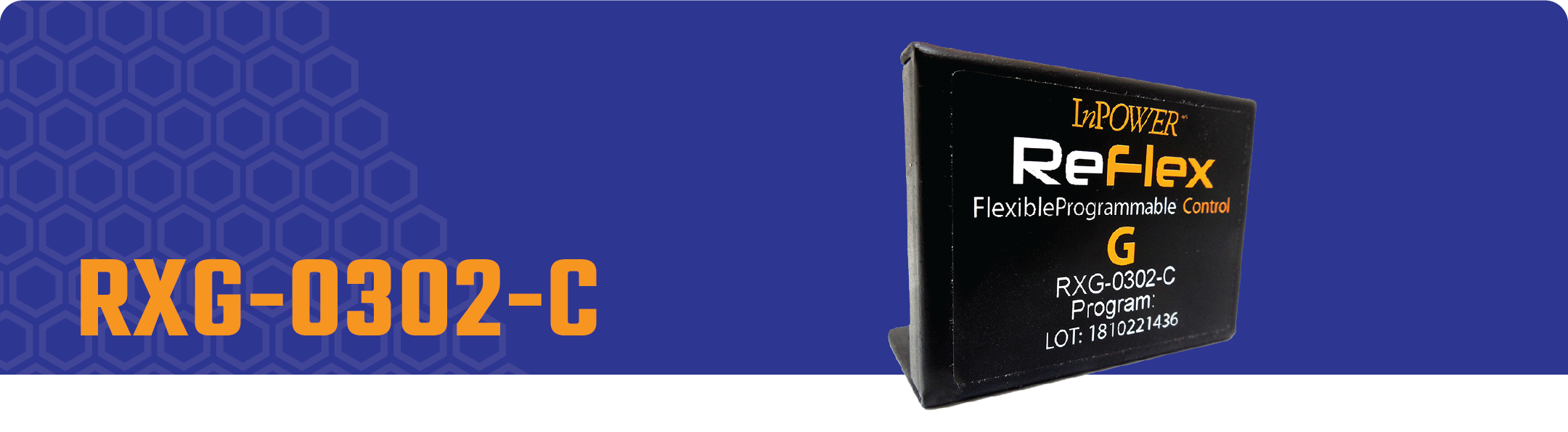
Replacing a relay with a programmable control means swapping a stack of single-purpose electromechanical relays for one solid-state module that handles the same switching in software. Instead of wiring relays together to build a function, you program the logic into a module that already carries the inputs and outputs it needs.
A traditional relay does one thing. It energizes a coil, closes a contact, and passes current. Build anything logical on top of that, a timer, an interlock, a sequence, and you add another relay, more wire, and more connections. A programmable module folds that logic inside. InPower’s ground-output Reflex RXG-0302 gives you three voltage inputs and two ground outputs with programmable logic and delays, in a module built to eliminate the need for bulky relay banks. The RX-0202 delivers two 15-amp outputs through a single sealed connector, and can be programmed for different functions before installation[1]. One module, defined in software, takes the place of a handful of relays and all the wiring between them. We ran the labor math on that trade in Save Space, Labor, and Cost on Your Next Upfit.
Why are work truck relays a weak point?
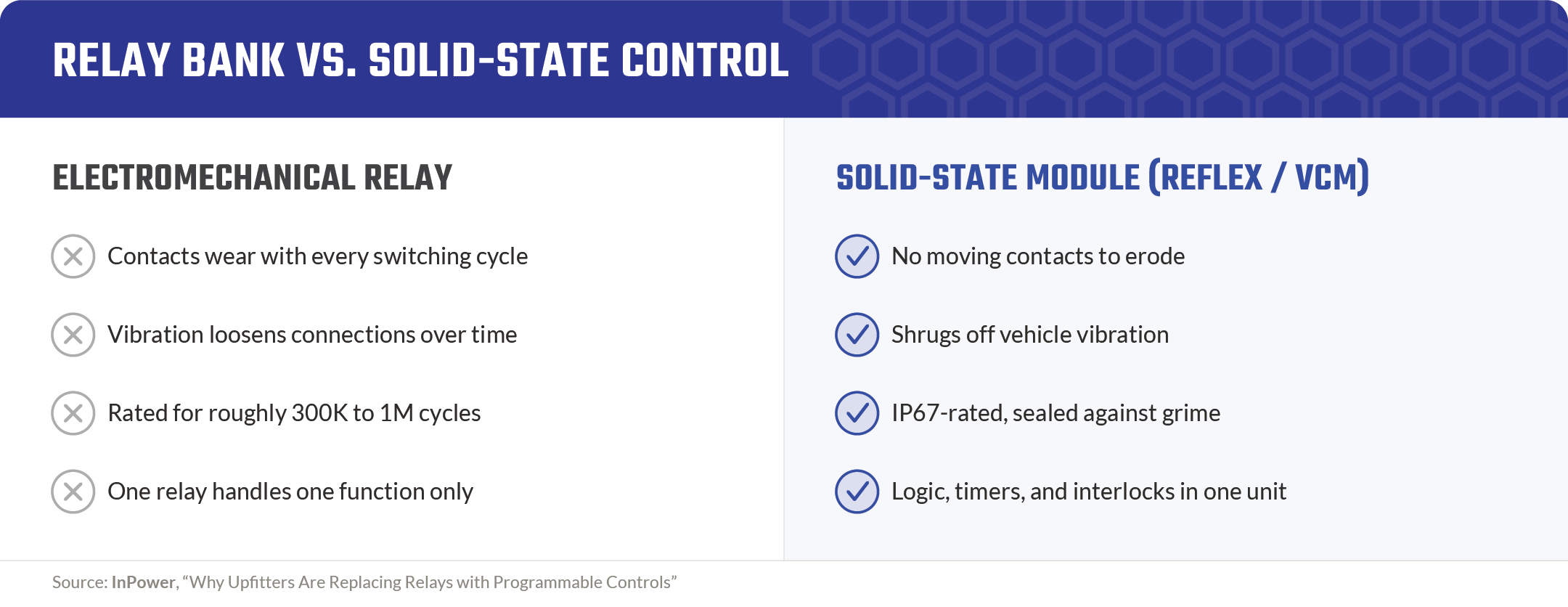
Work truck relays fail because they depend on moving parts, and few places punish a moving part like a work truck: constant vibration, temperature swings, dust, and moisture.
Relays have other issues besides installation labor. A relay switches by physically closing a metal contact, and those contacts wear with every cycle. Vibration loosens connections and fatigues terminals over time. Manufacturers typically rate mechanical relays for a few hundred thousand to around a million switching cycles (solid-state vs electromechanical relays), and rough duty gets you to that limit sooner. Multiply one relay by the dozen in a busy panel and you multiply the points that can quit. When one does, the truck sits and someone traces wires to find it.
How do solid-state controls hold up better?
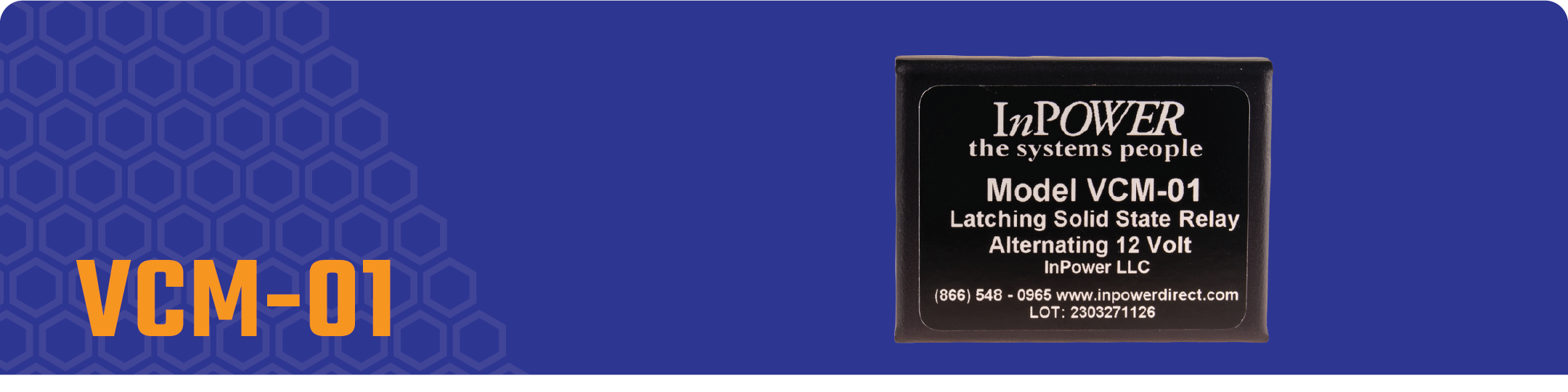
Solid-state controls switch with semiconductors instead of moving contacts, so nothing wears out, bounces, or shakes loose. That design lets them outlast mechanical relays in vehicle service[2].
With no contacts to erode, a solid-state relay handles far more switching cycles than a mechanical one and shrugs off the vibration that kills moving parts (relay design comparison). InPower’s 12-volt VCM smart relays replace the coil and contact with a programmable, solid-state switch. Take that same design and give it an IP67-rated housing and you have the Reflex line, which adds logic, timers, and multiple inputs and outputs in one rugged package. Fewer parts to fail, and the housing keeps out the grime that works its way into everything on a work truck. To see how the family scales from a single smart relay up to multi-load systems, read Keep it in the Family.
When should an upfitter choose programmable controls?
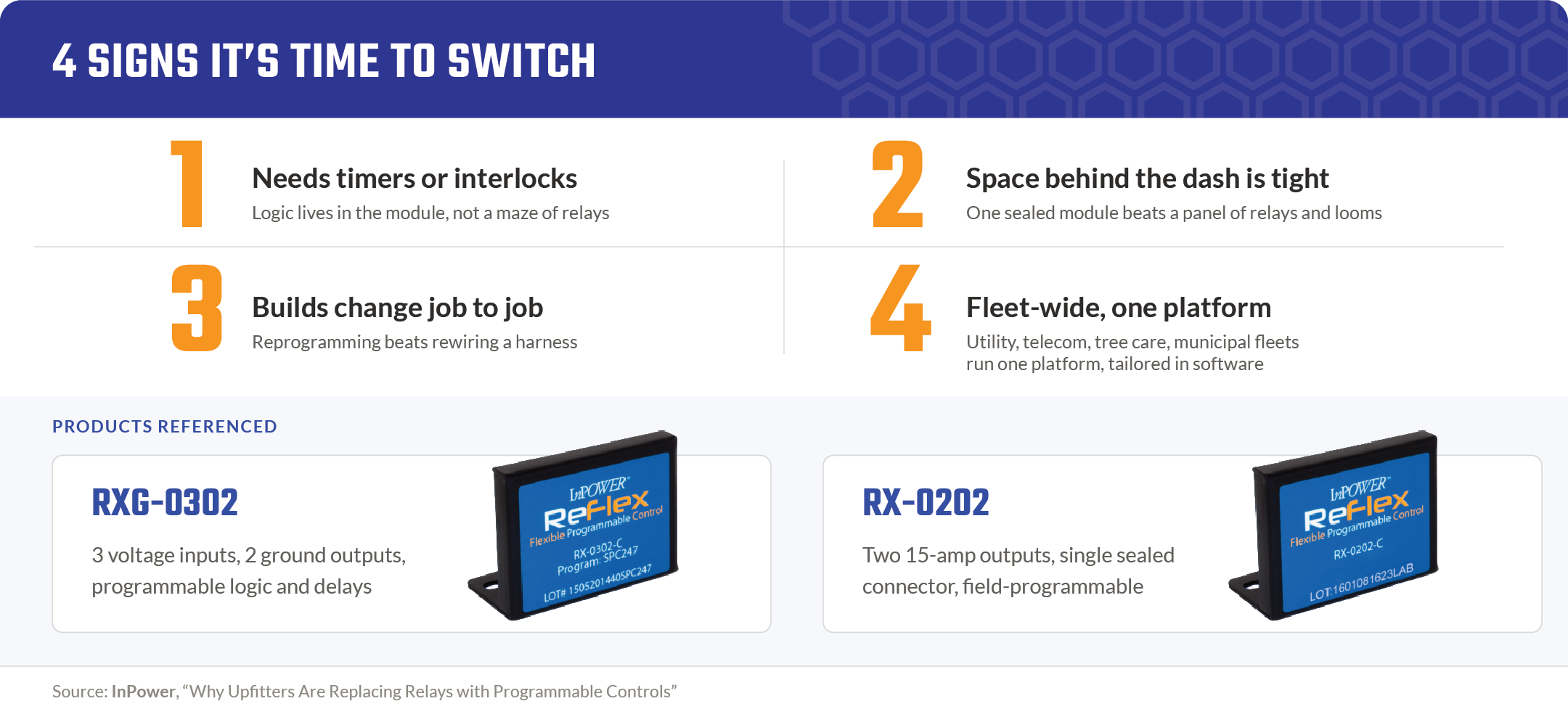
Programmable controls make the most sense when a build needs logic, runs in a tight space, or changes from job to job, which describes a large share of work truck upfits.
If a system needs timers, interlocks, or sequencing, that logic lives in the module instead of in a maze of relays. If the space behind the dash is tight, one sealed module beats a panel of relays and looms. Short or frequently changing build runs benefit most of all, because reprogramming a module takes a fraction of the time it takes to rewire a harness. Relays still earn their place in some circuits, and when a build needs a relay for a noisy circuit along with real logic and timing, our VCMR modules give you both. Utility, telecommunications, tree care, and municipal fleets all run these custom builds, and because the same modules get tailored in software, one platform can cover many jobs. We get into that flexibility in The VCM: One Hardware Design, Hundreds of Possibilities.
How InPower builds intelligent vehicle controls
InPower builds a full family of intelligent vehicle controls, from single solid-state smart relays to programmable Reflex modules and multi-load systems, all designed and assembled in Lewis Center, Ohio.
Every module shares one idea: rugged hardware with programmable intelligence, set to the job in software instead of wired into place. Decide how much current you need to control and how you want to control it, and we handle the rest. The people who answer the phone know the vehicles, because they helped design the parts.
If your builds still run on relay banks, let us help you find the module that clears the panel. Call us at 740-548-0965 to talk through your application.
[1] Programming requires special hardware and software, available separately from InPower.
[2] Additional protections such as external blocking or clamping diodes may still be required to protect against kick-back when powering high-inductance loads.