Every upfit on a new platform starts with the same question: where do I pick up my signals? On the 2026 Ford Transit, the park, park brake, ignition, and engine run signals no longer live on wires you can find with a test light. They travel as messages on the chassis data bus. You can still get them as plain, hardwired outputs for your build. You need a translator, not a test light.
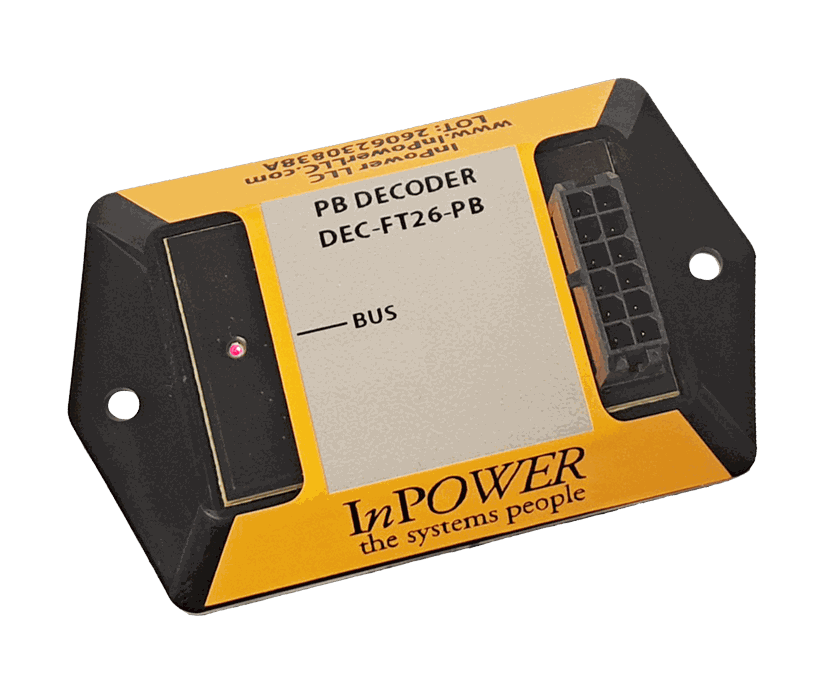
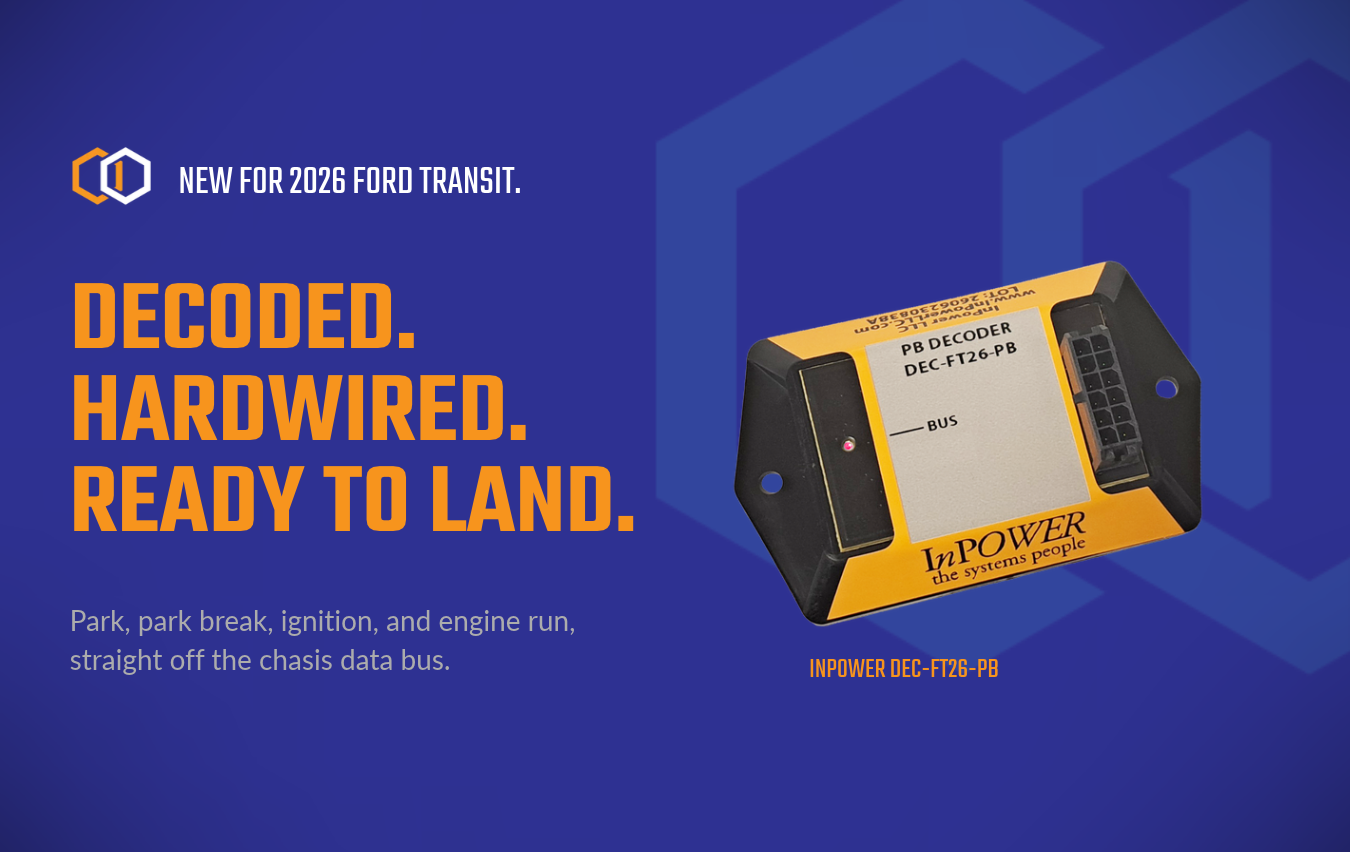
That translator is the DEC-FT26-PB, InPower’s data bus decoder built for the 2026 Transit.
Where do upfit signals live on the 2026 Ford Transit?
On the 2026 Ford Transit, vehicle-status signals such as park, park brake, ignition, and engine run live on the chassis data bus as digital messages rather than on discrete, tappable wires. The hardware that carries them sits behind the steering column, inside the factory network.
Ford has moved signals onto the bus for years, and its own body builder guidance steers upfitters away from wire splicing wherever a factory connection point exists (Ford Body Builder Advisory Service). We covered why the platform works this way, and what it means for interlocks and idle control, in Stop Splicing Wires: A Smarter Way to Upfit. The short version: the signals never left. They changed format.
What is a Ford Transit data bus decoder?
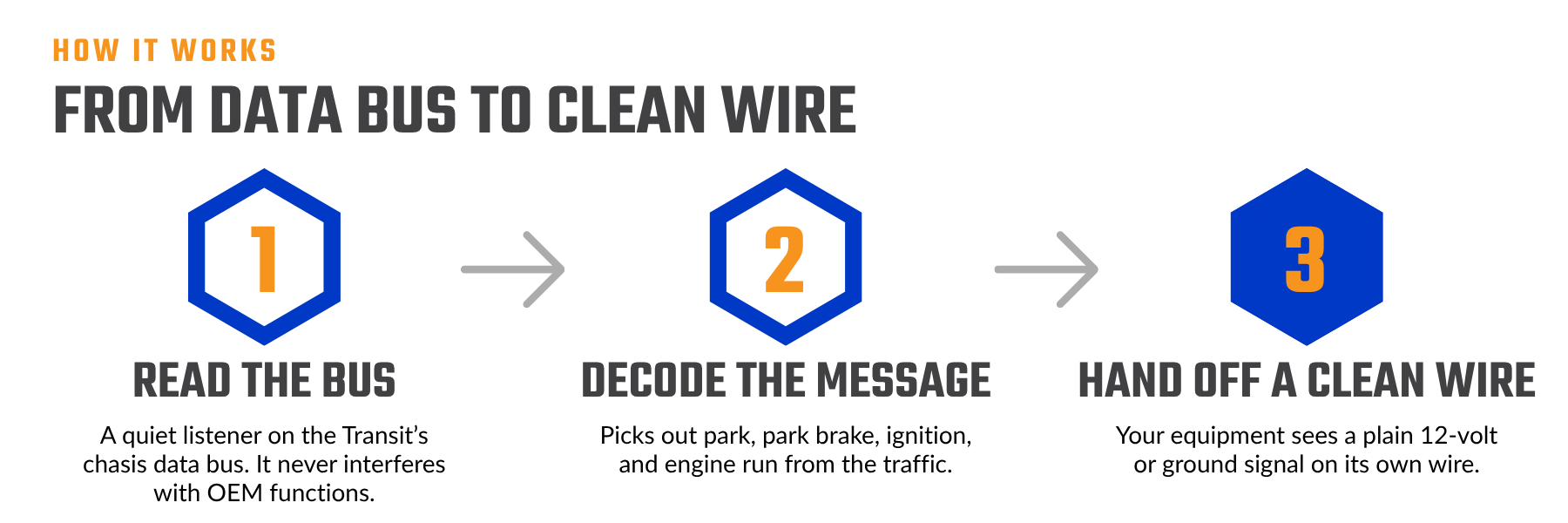
A Ford Transit data bus decoder is a compact module that listens to the chassis data bus, picks out specific vehicle-status messages, and converts them into discrete hardwired outputs your build can use. Your equipment sees a plain 12-volt or ground signal. The vehicle sees a quiet listener that never interferes with OEM functions.
InPower has built chassis data bus decoders for Ford and GM platforms for years, going back to modules like the DEC-FD23-PB for the 2023 Ford Super Duty. The approach stays the same across every one of them: read the bus, decode the message, and hand the installer a clean wire. The DEC-FT26-PB brings that approach to the 2026 Transit.
Which signals does the DEC-FT26-PB provide?
The DEC-FT26-PB provides four decoded outputs from the 2026 Ford Transit’s data bus: the park and park brake signals (both GND true), plus ignition and engine run (both 12V true). Each signal arrives on its own blunt cut wire, ready to land in your build.
Park rides the violet wire and park brake rides the dark green, both switching to ground when active. Ignition comes out on brown and engine run on blue, both 12-volt true. A gray enable input switches the outputs on, output current is rated to a maximum of 800 mA, and the module draws 2.5 milliamps on standby. The whole package measures 3.2 by 1.9 by 0.8 inches, small enough to disappear behind the column. The full pinout lives on the DEC-FT26-PB product page and in the PDS-291 data sheet.
How does the DEC-FT26-PB install without splicing?
The DEC-FT26-PB attaches to the rear of the Ford Steering Column Control Module (SCCM), where its DEC-FTS4-PB cable picks up power, ground, and the data bus straight from the factory connection. No OEM wire gets cut, and the installation stays low cost, fast, and easy.
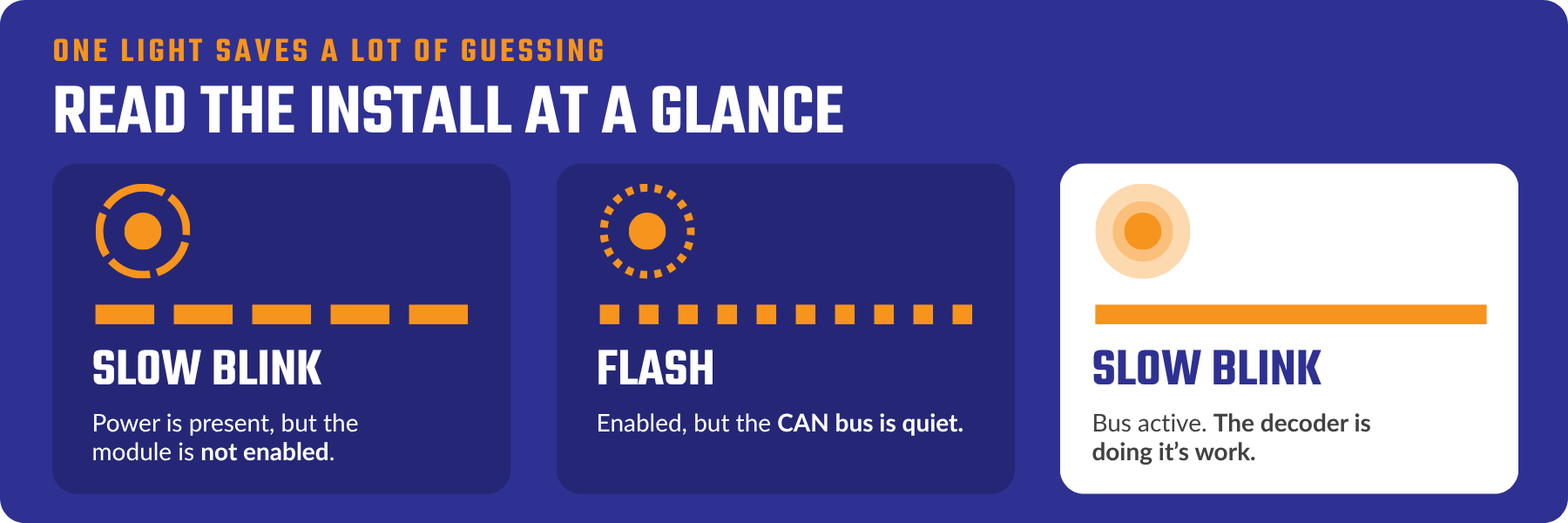
A BUS status LED tells you what the module sees. A slow blink means power with no enable. A flash means the module is enabled but the CAN bus is quiet. Solid means the bus is active and the decoder is doing its work. When something in an install misbehaves, that one light saves a lot of guessing.
What if your build needs more than signals?
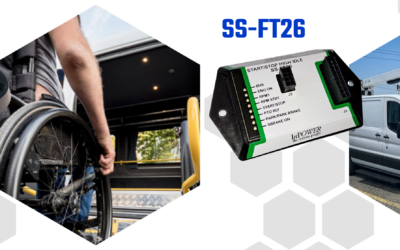
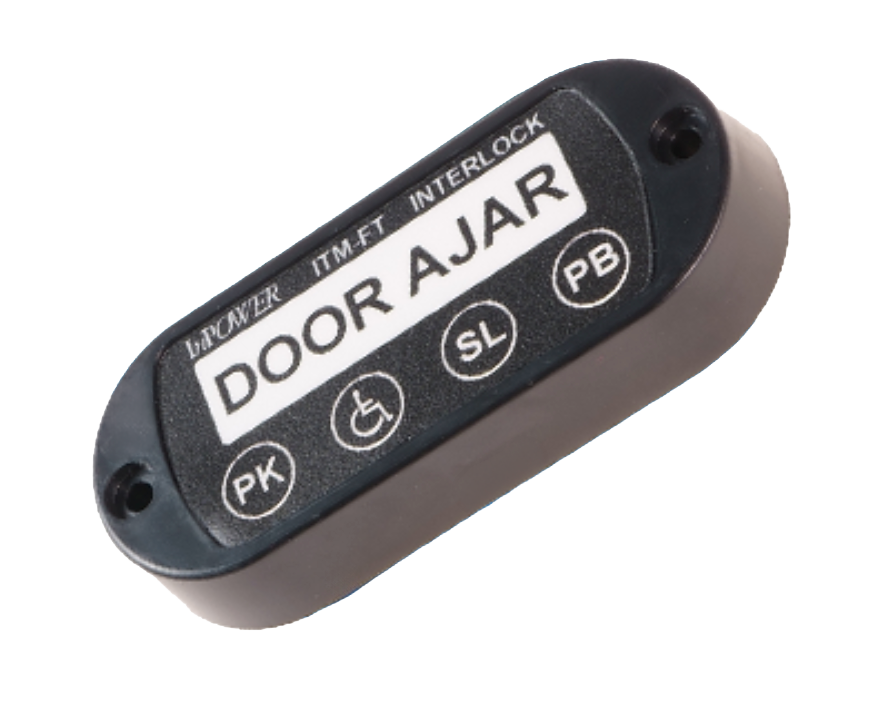
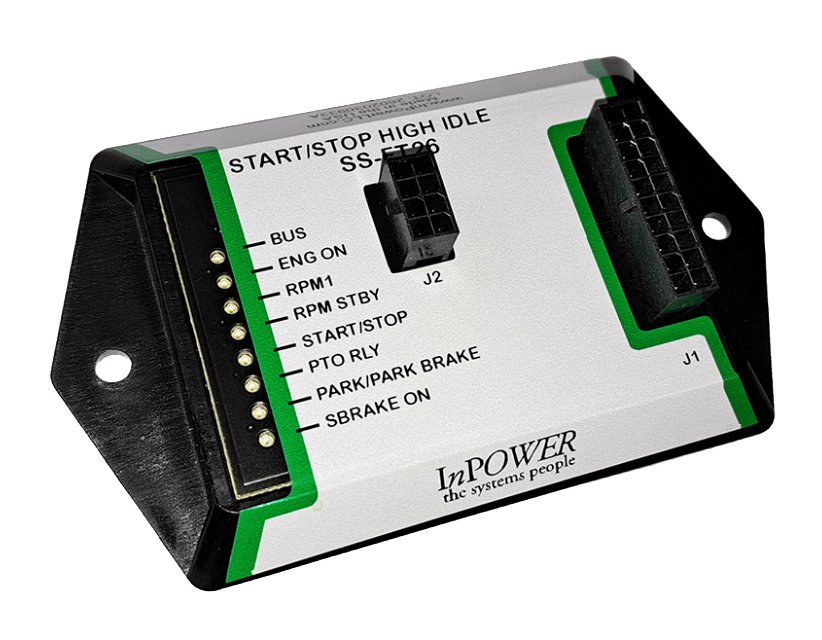
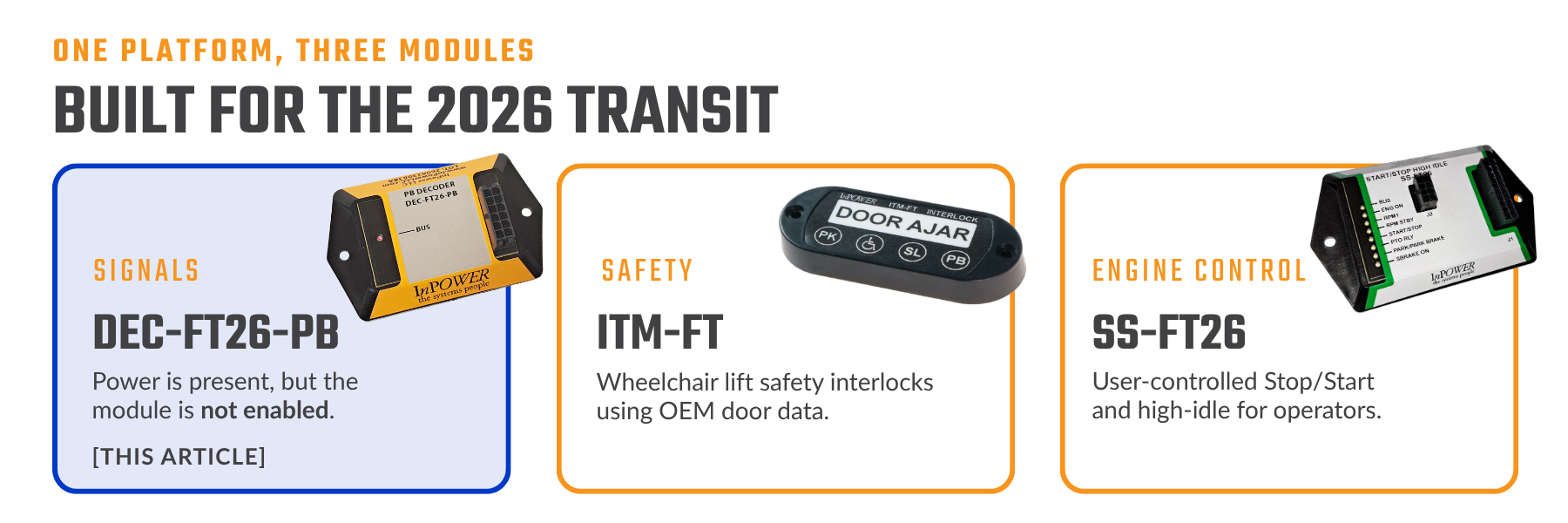
The DEC-FT26-PB is one of three InPower modules built for the 2026 Transit. The ITM-FT handles wheelchair lift safety interlocks using OEM door data, and the SS-FT26 gives operators user-controlled Stop/Start and high-idle. Together they cover signals, safety, and engine control on the new platform.
And if the signal you need is missing from the standard set, customized functions are available. We design and manufacture everything at our own facility in Lewis Center, Ohio, so a custom decode starts with a phone call rather than a redesign. Call us at 740-548-0965 to talk through your 2026 Transit build.
[Footnote] All signal names, OEM wire colors and markings, polarities, and current ratings were taken both from the Ford Body Builder Advisory Service, and direct examination of field examples Model-Year 2026 vehicles. However, wire specifications, locations, and connection points are periodically subject to change. Always check the vehicle’s VIN, and consult the Ford Body Builder Advisory Service for current specifications before beginning any upfit.